
|
 |
|
Visit The *EVEN NEWER* Barrow-Downs Photo Page |
 08-13-2012, 06:20 AM
|
#41 | |
|
Ghost Prince of Cardolan

Join Date: Aug 2012
Posts: 785
 |
Quote:
Again, it's only obvious from our perspective, a perspective we cannot assume to be universal. It's also worth considering that sieges of that nature were uncommon in Gondor, and in the later centures of the Third Age the Men of Gondor had spent most of their military endeavours in open battles, street-fighting in Osgiliath, skirmishes in Ithilien and Naval combat against Umbar and the Men of the Harad. Minas Tirith itself had not been beseiged since the end of the Second Age over three thousand years earlier, and so its unique defensibility had realistically never had a chance to be fully realised and exploited. Perhaps at the end of the Third Age the Men of Gondor simply lacked the experience or technological expertise to make engines of that nature and utilise them effectively. We must remember that this was not really the medieval world and the state of warfare was not identical to that of a period of real history. What I'm trying to say is that while I do agree with you that Minas Tirith probably would have been very well served by powerful artillery, I personally don't believe that the lack of artillery in the book is necessarily some kind of internal logical inconsistency on the part of Professor Tolkien when writing. I'm afraid to say that the Men of Gondor were not perfect and did not always think of everything, including things that might seem blatantly obvious to us. That being said, if this point is indeed "one of the greatest plot holes" in The Lord of the Rings then we can be extra thankful that we got a book with such a tight and consistent plot. I personally never liked the way the Men of Minas Tirith were given trebuchets in the films - they are too explicitly medieval/early Renaissance and too mechanical for me, which doesn't really fit with how I imagine the Dúnedain. Last edited by Zigûr; 08-13-2012 at 06:37 AM. Reason: clarification |
|

|

|
|
08-13-2012, 07:30 AM
|
#42 |
|
Wight

Join Date: Apr 2011
Location: Settling down in Bree for the winter.
Posts: 208
|
 History?
The notion that fortified cities often have less siege machinery than those outside the walls seems historical. One would think that if a people expends effort and money to build these big walls they would spend some effort on catapults and similar devices. Yet, does anyone know of walled cities with platforms for siege engines built into the walls?
|
|
|
|
|
08-13-2012, 04:40 PM
|
#43 | ||||
|
Animated Skeleton
Join Date: Jul 2012
Posts: 28
|
Galadriel55, most of your arguments have been refuted already. To see what I mean, read the posts titled:
My Grand Refutation to the General Counter-Arguments Made Against Me / My Grand Refutation to the General Counter-Arguments Made Against Me(Cont'd) / My Grand Refutation to the General Counter-Arguments Made Against Me (FINISH) Most of my replies on this post will be a reiteration of things that I have either explicitly stated or implied. Quote:
Besides artillery, there were also other highly dangerous tools (and creatures) on the Mordorian side, and these are the Oliphaunts, the armored trolls and the siege towers. Being large and heavily protected, all of them are best left for the artillerymen to kill and destroy.. Quote:
I thought that this is a civilized forum that deals mostly with evidence and reason. The majority of the people against me may repeat the same things over and over, but that does not make their arguments true, especially when they have not provided much evidence. Quote:
Quote:
Last edited by TheAzn; 08-13-2012 at 05:03 PM. |
||||
|
|
|
|
08-13-2012, 04:59 PM
|
#44 | |
|
Animated Skeleton
Join Date: Jul 2012
Posts: 28
|
Quote:
My Grand Refutation to the General Counter-Arguments Made Against Me / My Grand Refutation to the General Counter-Arguments Made Against Me(Cont'd) / My Grand Refutation to the General Counter-Arguments Made Against Me (FINISH) |
|
|
|
|
|
08-13-2012, 05:16 PM
|
#45 | |||
|
Blossom of Dwimordene

Join Date: Oct 2010
Location: The realm of forgotten words
Posts: 10,553
|
Quote:
Quote:
Agree to disagree? Quote:
Why does it matter so much to you to prove that Tolkien left a plot hole? And so what if he did? So agree to disagree?
__________________
You passed from under darkened dome, you enter now the secret land. - Take me to Finrod's fabled home!... ~ Finrod: The Rock Opera |
|||
|
|
|
|
08-13-2012, 05:28 PM
|
#46 | |
|
Animated Skeleton
Join Date: Jul 2012
Posts: 28
|
Quote:
|
|
|
|
|
|
08-13-2012, 05:46 PM
|
#47 | ||
|
Animated Skeleton
Join Date: Jul 2012
Posts: 28
|
Quote:
Quote:
If you want to know my complete arguments, please read the posts titled: My Grand Refutation to the General Counter-Arguments Made Against Me / My Grand Refutation to the General Counter-Arguments Made Against Me(Cont'd) / My Grand Refutation to the General Counter-Arguments Made Against Me (FINISH) The posts are located on the bottom half of page 1. |
||
|
|
|
|
08-13-2012, 05:55 PM
|
#48 | ||
|
Animated Skeleton
Join Date: Jul 2012
Posts: 28
|
Quote:
Quote:
|
||
|
|
|
|
08-13-2012, 09:03 PM
|
#49 | |
|
Shade of Carn Dûm
Join Date: Apr 2001
Location: Toronto
Posts: 479
|
Quote:
Claiming that criticisms of your arguments have been disputed without indicating where doesn’t work with me. Mostly you appear to just ignore criticism and jump to irrelevancies that a falling palantír would almost certainly kill a man if it hit him straight on. You are only assuming that Minas Tirith even had siege engines. The text doesn’t back up your assumption anywhere. Quite likely it can be taken as something that should go without saying, but in medieval accounts of siege warfare that I have read almost all the siege engines were in the hands of the attackers, not in the hands of the defenders. Seemingly siege engines were far more useful for attackers to use against fortress walls than for defenders to use against moving targets, as seems reasonable to my thinking and to those of some others here. Diagrams of siege engines on the top of Minas Tirith don’t prove anything when an accurate diagram shows that a siege engine lobbing a rock would lob it just as far if the siege engine was on an outer wall. The first throw might well kill 10 or 20 of the foe at most. Then the foe would see the stones were coming and get out of the way. When using a catapult to lob stones at the walls, walls don’t run away. The foe can find somewhere they think there is a weak point, and keep lobbing at the same place, hoping that the stone will crack there. But Tolkien explains clearly why this tactic is not used at Minas Tirith. Here the walls had been built too strongly. It seems to be a fact in medieval and older battles that siege engines were not greatly used by the defenders in a siege. If you think I and others are wrong, and in theory we might be, then point out historical counter-examples. Just saying Tolkien was wrong in his writing, was horrendous beyond words, doesn’t convince me at all. Those are only the empty words of someone who has provided no evidence that Tolkien was wrong. That historically defenders of a besieged fortress didn’t greatly rely on siege engines seems to be the best evidence that siege engines were less useful in the defense of a fortress than you imagine. Claiming that your posts support your arguments when they don’t doesn’t strengthen your arguments. Last edited by jallanite; 08-13-2012 at 09:13 PM. |
|
|
|
|
|
08-14-2012, 12:37 AM
|
#50 | |||||||||||
|
Animated Skeleton
Join Date: Jul 2012
Posts: 28
|
Quote:
Quote:
Quote:
1) The first would be the Hornburg. The attack upon Rohan was sudden too. Yet, the Hornburg was relatively well prepared. This is despite the fact that Theoden has just recently been freed from the influence of Saruman. 2) Saruman was definitely caught off guard. Yet, merely a short time after returning to the Orthanc, he immediately figured out how to use Isengard its near fullest potential. The great forges were started and some Ents burned. Unfortunately for Saruman, this just makes the Ents more angry. Still, people can do amazing things even when surprised. Quote:
Quote:
Quote:
Quote:
Quote:
Quote:
Below is a video showing Pre-teens firing their homemade artillery: http://www.youtube.com/watch?v=mRazO...6157DAE738106D Quote:
Quote:
Last edited by TheAzn; 08-14-2012 at 01:06 AM. |
|||||||||||
|
|
|
|
08-14-2012, 04:51 AM
|
#51 | |||
|
Ghost Prince of Cardolan
Join Date: Aug 2012
Posts: 785
|
Quote:
Quote:
Quote:
|
|||
|
|
|
|
08-14-2012, 05:52 AM
|
#52 | ||||||||||||||||
|
Animated Skeleton
Join Date: Jul 2012
Posts: 28
|
I am not sure how useful my responses will be, but I will give it a try.
Quote:
Quote:
Quote:
Quote:
Quote:
And what irrelevancies? In case you do not remember, one of the points that miss Gal kept on repeating was that, because they only need to fling light materials like human heads, the Mordorians can outrange the Gondorians. I refuted her arguments by stating what should have been the obvious: the Gondorians most likely used light projectiles as well. There is of course, a problem with this rebuttal. The Mordorian projectiles were not meant to cause physical damages, while the Gondorian projectiles must. This is when I brought in the palantir as an easy to understand example. Can light Gondorian projectiles cause substantial damages? The answer is absolutely yes, and most of the last page are dedicated to me giving the evidences. Quote:
Quote:
So what are my evidences? 1) Even without the threat of Mordorian artilleries, there are still overwhelming incentives for the Gondorians to build the best artilleries possible. These incentives are the threats of the Mumakils,armored trolls and siege towers, all of which the archers themselves cannot handle alone. Like all human beings, I presume that the Gondorians would respond to strong incentives. And this presumption is most likely sound, for a lot of ancient cities with sizeable walls very likely had artilleries on them. See post below for evidence. 2) Although Minas Tirith has not been besieged in a long time, the other important cities surrounding the area most likely experienced sieges frequently. This alone creates many chances for artilleries to be invented (if they are not already) and enhanced. 3) Despite the incentives, it is true there would not be much artilleries if there are no spaces. Non-essential building could have been torn away create more space. The Ship Rock is secure and is enhanced by the “a mighty craft”. Based on the description of the book itself, there are no lack of spaces on the Upper Deck. With such overwhelming incentives to use artilleries, and not much reasonable hindrances, Gondor most likely did use artilleries on Minas Tirith. 4) Finally, it is a fact that building respectable ancient artilleries is not really hard. Even Highschool students can build such devices. With such overwhelming incentives to use artilleries, and not much reasonable hindrances, Gondor most likely did use artilleries on Minas Tirith. http://www.youtube.com/watch?v=JWXEqJlj8pM Quote:
Quote:
Quote:
Quote:
Quote:
Quote:
Quote:
Quote:
Quote:

Last edited by TheAzn; 08-14-2012 at 10:58 AM. |
||||||||||||||||
|
|
|
|
08-14-2012, 06:37 AM
|
#53 | |
|
Animated Skeleton
Join Date: Jul 2012
Posts: 28
|
Quote:
One example that springs to my mind is the fortress of Euryalos connected to the New Wall of Syracuse, on the west side of the Epipolai Plateau. This is after all where the catapult was invented. The katapeltikon (arrow projector) and lithobolos (stone projector). Later the Romans called them Catapulta and Ballista respectively. The fortress of Euryalos was built solely for the purpose of having stone projectors and arrow projectors on top of. This held the North of Syracuse safe until 212 BCE when Marcellus invaded it. 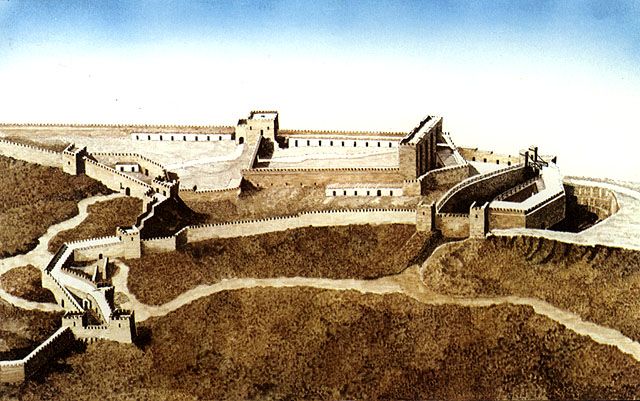 Other than Euryalos, there's been many more finds in Greek territories of walled artillery positions. Schramm excavated and analyzed the ruins at Ephyra finding the same. Washer-plates from catapults were found, and the walls were of sufficient width and volume that they were not just meant for soldiers. Source: Greek and Roman Artillery 399 BC-AD 363 .................................................. .... To keep with the European theme for a moment, one need to look no further than the great Julius Caesar himself. Even in something temporary like Roman camps, ballistas were kept within wooden "towers", ready to be used at any moment. Sources: Caesar: Life of A Colossus .................................................. .... But what about other cultures? In terms of China, there are both textual as well as archeological evidence of wall mounted artillery from as far back as the Han dynasty. I believe that Joseph Needham's volume on catapults covered this the best. Source: Science and Civilisation in China: Volume 5, Chemistry and Chemical Technology, Part 6, Military Technology: Missiles and Sieges by Joseph Needham and Robin Yates I am not familiar with the artilleries of other Non-European cultures, so I might have to do more research on them. .................................................. .... Last edited by TheAzn; 08-14-2012 at 10:59 AM. |
|
|
|
|
|
08-14-2012, 10:22 AM
|
#54 |
|
A Northern Soul

Join Date: Dec 2001
Location: Valinor
Posts: 1,847
|
A friendly reminder...
Don't take personal offense to differing opinions. It's not necessary to call people wrong, confused, or ignorant, especially when dealing with less explicit features of the stories. Continue to make your case without personal remarks.
__________________
...take counsel with thyself, and remember who and what thou art. |
|
|
|
|
08-14-2012, 10:56 AM
|
#55 | ||
|
Laconic Loreman

Join Date: Feb 2004
Location: USA
Posts: 7,522
   |
Quote:
I can not follow arguments you had not posted yet, because I can not read arguments that do not exist. However, now that you have posted your latest counters and kindly directed me to them, I can follow quite well... Quote:
__________________
Fenris Penguin
Last edited by Boromir88; 08-14-2012 at 12:31 PM. |
||
|
|
|
|
08-14-2012, 11:34 AM
|
#56 | |||||||||||||||
|
Shade of Carn Dûm
Join Date: Apr 2001
Location: Toronto
Posts: 479
|
Quote:
Quote:
Quote:
Galadriel55 was right and you were wrong, wrong, wrong, wrong. Special pleading only makes your arguments seem worse. Quote:
Quote:
Quote:
Quote:
There was none upon the City walls large enough to reach so far or to stay the work.It is pressing the words too hard to claim that possibly a load of light gravel might have reached the catapults of Mordor. But a claim that the catapults on the city walls could have reached the catapults of Mordor with a load heavy enough to have caused damage would only be true in a battle that you are imagining, not in the battle you claim to be discussing. You surely must admit that in the real world some catapults have a longer range than others. Then this should not cause a problem in Tolkien’s world. That the catapults from the city could not reach the catapults of Mordor is one of the pieces of data in the story. Saying that this data is wrong doesn’t prove a thing when that data is perfectly reasonable. Your refutation fails because it begins by assuming that the data is incorrect when there is no reason to think it is. Quote:
Your presumption is that catapults of Minas Tirith must have been of the same strength or stronger than those of Mordor. In this story, you are simply wrong. Sauron had stronger catapults. That the catapults of Minas Tirith were exactly as strong as those of Mordor or stronger is just something you have made up. Tolkien says differently and there is nothing unreasonable in what Tolkien indicates here. Nothing. Quote:
Quote:
Quote:
Quote:
Quote:
Possibly there were a few. But I believe that they were not the norm which strongly suggests that siege engine had generally proved to be more useful to attackers than to defenders. Are you perhaps terrified at looking at history? Quote:
Quote:
You originally appeared to suggest that since catapults in Minas Tirith could be higher than those of Mordor, that they would have greater ranger than the catapults of Mordor. That argument was entirely fallacious. Last edited by jallanite; 08-14-2012 at 01:44 PM. |
|||||||||||||||
|
|
|
|
08-14-2012, 01:29 PM
|
#57 | |||
|
Laconic Loreman
Join Date: Feb 2004
Location: USA
Posts: 7,522
|
Quote:
Large siege engines are offensive weapons, designed for the purpose of breaking through a fortified city's main defense (the wall). It does not do much good for the city to place siege engines on its walls if the walls themselves are not strong enough to keep attackers out. Anyway, point is, siege engines were often built on the spot, and could easily be greater than any siege equipment placed on a city's walls for defense. Since, the main purpose of the siege engine was offensive, and to break down walls. A city did not need to break down walls, it just needed to be fortified enough to keep attackers out. (And now moving back towards the more specific discussion regarding the siege of Minas Tirith). Minas Tirith's first wall, was in fact indomitable. TheAzn, you may not like this magical explanation in the books, but that's how it was and there is no way around it. Minas Tirith was a foritified city and its primary defense was the impregnable first wall: Quote:
However, Sauron recognizing the strength of Minas Tirith is in it's outer wall, does not waste time or resources trying to break through it (which was the reason the defenders "At first laughed," believing Sauron had built these large catapults to bring down their wall): Quote:
As others have argued, the reasons presented in the text for Sauron's army being out of range of Minas Tirith's siege equipment are logical and consistent, within the text. Orcs delighted in building machines and playing with wheels, especially machines that could be implemented for nefarious purposes. Saruman was said to have a "mind of wheels and metal." Saruman was a Maia of Aule, as was Sauron, they were both great craftsman. Maybe you don't think in siege equipment the men of Minas Tirith should have been outmatched by orcs and Sauron, but in LOTR, that's how the story is presented. That is how the story is also consistently explained. So, in my opinion, no plothole exists.
__________________
Fenris Penguin
Last edited by Boromir88; 08-14-2012 at 01:38 PM. |
|||
|
|
|
|
10-29-2012, 10:52 PM
|
#58 |
|
Newly Deceased
Join Date: Aug 2011
Posts: 8
|
The intelligence of the Gondorians might have been excellent, but there is always room for error and unpreparedness! Many, with Jallanite at the fore, have noted T. covered the angles on this subject, for the most part.
Two quotations come to mind of the risks of assuming one's preparedness in war. The first of these being a song that might very well have had a primitive parallel in Orcish on that day: "Whatever happens we have got, The Maxim gun, and they have not". -Hilaire Belloc The second, from U.S. Gen. Patton, regarding the use of walls (and, presumably, trenches): “Fixed fortifications are monuments to man's stupidity,” Comfort and safety can lead to hubris! |
|
|
|
|
12-15-2012, 12:45 AM
|
#59 |
|
Haunting Spirit
Join Date: May 2012
Posts: 58
|
It would be a mistake to say that Tolkien did something wrong and Jackson did right. I'm not saying that Middle Earth is perfect but there isn't really much that Tolkien can improve on in his world, really.
__________________
What did Aragorn say when Gandalf died in Moria? Damn Gulf |
|
|
|
|
12-20-2012, 07:03 PM
|
#60 |
|
Animated Skeleton
Join Date: Dec 2012
Posts: 49
|
Artillery not used by defenders
I don't think artilley was used MUCH by the defenders of castles in medieval battles - for the simple reason that they were not very effective against armies.
It's difficult to hit someone standing 500 metres away hurling a rock at them - they will tend to move  Towers, however, do not move, so it makes sense throwing rocks at them. Towers, however, do not move, so it makes sense throwing rocks at them.From my somewhat scant knowledge of medieval warfare archery was effective if you had a big group of bowmen firing at once - this way you get a swarm of arrows, and the other army cant jump away becuse there's arrows everywhere. I think it would be much more useful for the defending side to put the ressources into archery than artilley - why dedicate 10 men and a lot of wall space to operating a fairly inefficient artillery piece, when you could have instead 30 archers in the same space firing arrows (assuming the pile of rocks and the machine itself takes up the space of 20 men) at a MUCH higher hate. You can fire an arrow every two seconds or so - while i suppose it would take at least several minutes to load an artillery piece. It means the choice is betwen one rock every two minutes or 1200 arrows being fired continually in the same two minutes. I don't think the artillery was very maneuverable. Like if you needed to change the angle 30 degrees right because they moved a siege tower - I don't think it was fast. I'm a bit surprised of the roman castle stuffed with artillery. Maybe there's something special going on here - like an advancing army being forced intp a very tight space by the local geography. The medieval castles I was - not very many I admit - does not look like a lot of space was dedicated to artillery either. I'll look closer next time I see one
|
|
|
|
 |
|
|
|
|


 Linear Mode

