
|
 |
|
Visit The *EVEN NEWER* Barrow-Downs Photo Page |
 03-05-2009, 01:45 AM
|
#14 | |
|
Illustrious Ulair

Join Date: Aug 2002
Location: In the home of lost causes, and forsaken beliefs, and unpopular names,and impossible loyalties
Posts: 4,240
 |
Part of the effect of the longbow in battle was rate of fire - an English archer could loose anything from 15-20 arrows a minute. Records for Towton in 1461 (where both sides had archers) estimate that half a million arrows were loosed in 10 minutes
Quote:
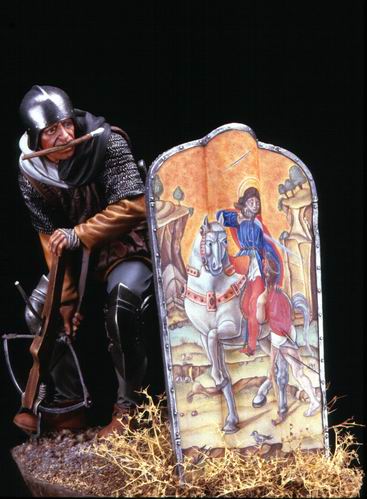 which would mainly be adding to the colour of the battlefield with his pretty pavise..... which would mainly be adding to the colour of the battlefield with his pretty pavise.....The success of the archer in battles like Crecy, Poitiers, Agincourt & Towton was down to rate of fire & the number of arrows that could be loosed - it depended little on accuracy - basically it was like charging into a solid, but very spiky, wall. The impact would knock you over, & then you'd have virtually no chance of getting up again before you were trampled to death (usually by your own side). Yes, you can carry a crossbow loaded & cocked, but if you missed, then once your first shot was loosed an archer could put a dozen arrows into you before you could get off a second shot. Also you have the problem of weather - at Crecy there had been a sharp rainstorm just before the battle which had weakened the strings of the crossbows carried by the Genoese, whereas the English carried spare bowstrings in their helmets which were nice & dry & could re-string their bows quickly. It was the gun which put paid to the bow, not the crossbow, & it took a long time for guns to develop to the required standard of reliability & effectiveness.
__________________
“Everything was an object. If you killed a dwarf you could use it as a weapon – it was no different to other large heavy objects." Last edited by davem; 03-05-2009 at 01:48 AM. |
|

|

|
|
|
|
|


 Threaded Mode