
|
 |
|
Visit The *EVEN NEWER* Barrow-Downs Photo Page |
 11-28-2012, 04:59 AM
|
#1 |
|
Itinerant Songster

Join Date: Jan 2002
Location: The Edge of Faerie
Posts: 7,066
 |
 Wizard Gone Missing
In my most recent reread of The Hobbit, I was struck by how Nordic are the Dwarves and the Wizard in "An Unexpected Party." I was just as fascinated by the portrayal of the Wizard as frankly sorcerous with the many-colored smoke rings floating above his head.
Through the story, it seems to me that some of this "Brothers Grimm" - feel - of the story is traded in, so to speak, in exchange for the story Tolkien has chosen to tell. This thought could stand some fleshing out, but I would prefer to leave it as an open subject for part of this thread's discussion. The thing that interests me most, however, is the difference between the Wizard depicted in "An Unexpected Party" as opposed to (1) Gandalf described later in the book, especially after Smaug has been killed; and also as opposed to (2) Gandalf the Grey, then White, the Istari of The Lord of the Rings. I place no value judgement on these differences that I see. Tolkien did what he chose, for his own reasons, and we are the richer for it. However, Gandalf does change, not once, not twice, but repeatedly, at least to my perception. I must admit that there is something very appealing about that first appearance of the Nordic Wizard that is still there mostly right up until he takes leave of the Hobbit and Dwarves before they enter Mirkwood; and this particular - er - feel - of the Wizard, seems never to return - and I miss him. Am I reading something into this that is not there? Does anyone else sense it? Are there points after Mirkwood when Gandalf again seems like this original Nordic Wizard, in The Hobbit? .... in LotR? |

|

|
|
11-28-2012, 04:21 PM
|
#2 |
|
A Voice That Gainsayeth

Join Date: Nov 2006
Location: In that far land beyond the Sea
Posts: 7,431
 |
Nice observation, elempi. Let me say a few things. From my point of view, I definitely agree with what you spotted there - Gandalf indeed has these several different "personalities" throughout the books, the most striking, which probably everyone notices since it is also an "outward change" is the Gandalf the Grey/Gandalf the White transition. The others are also true, the way you mention them.
But, at the same point - and I would especially emphasise it in regards to what you have said about the wizard ("This time, I am a conjurer of cheap tricks"  ) at the Unexpected Party - I would say that these can also be seen as mere personality changes, or different sides of the same personality in different situations. Think about it. A person often acts differently when at home with family, in a circle of friends, or at work, when being a high-placed politician, or as a conscript in the military or in the middle of a war. It can all be the same person but you'd probably agree he might seem very different in those different situations. ) at the Unexpected Party - I would say that these can also be seen as mere personality changes, or different sides of the same personality in different situations. Think about it. A person often acts differently when at home with family, in a circle of friends, or at work, when being a high-placed politician, or as a conscript in the military or in the middle of a war. It can all be the same person but you'd probably agree he might seem very different in those different situations.And that's it, in my opinion. When Gandalf is in the Shire, he is "resting" from his daily duties - a bit, even though even here he has his own agenda and is trying to get Thorin to take Bilbo along for some reasons - but you can see it everywhere, even in LotR. Among Hobbits, who are generally isolated from the worries of the world, Gandalf is on "holiday" and he can make fireworks and just have fun. Indeed, I think "being on holiday" is the best term - it's probably the only holiday Gandalf had ever enjoyed in Middle-Earth. So therefore, he acts like that* Wizard. *One small note. I object to the term "Nordic Wizard" you have used. I know you used it because you are aware that in other cultural context, Wizards can look differently - like e.g. some African shaman, to show some extreme case - but it is certainly not "Nordic", the thing you are talking about (if we both think the same thing). My country is not "Nordic" in any sense, yet the image of what "wizard" is is very much the same for me. "European", perhaps, in some way you could say, or whatever. I think "Wizard" suffices. That's just a note. You really made it sound - to me - as if that Gandalf should be something "alien" to me, which it is not. It is a Wizard, as much as I know Wizards from mythology I've been hearing from childhood. Unless by "Nordic" you mean "more northern than the Mediterranean". And even then who knows.
__________________
"Should the story say 'he ate bread,' the dramatic producer can only show 'a piece of bread' according to his taste or fancy, but the hearer of the story will think of bread in general and picture it in some form of his own." -On Fairy-Stories |
|
|
|
|
11-28-2012, 07:57 PM
|
#3 |
|
Shade of Carn Dûm

Join Date: May 2006
Location: Melbourne, Australia
Posts: 257
|
He's much more serious in TLotR. Halfway
into the Hobbit he diverts to Dol Guldor. There he senses Souron is the Necromancer. So things get darker and more serious for the wizards and White Council. It's logical it affected his mood. As well as growing suspicions about Saruman's intentions.
__________________
Head of the Fifth Order of the Istari Tenure: Fourth Age(Year 1) - Present Currently operating in Melbourne, Australia |
|
|
|
|
11-29-2012, 11:36 AM
|
#4 |
|
Itinerant Songster
Join Date: Jan 2002
Location: The Edge of Faerie
Posts: 7,066
|
Tolkien had no notion of LotR when The Hobbit was published, nor did the revision of The Hobbit in the early 60's change Gandalf.
I think it is sufficient to the discussion that Gandalf became more serious toward the end of the Hobbit on the merits of the thing growing from a 13 Dwarf gambit into a touchy inter-cultural (and inter-species) negotiation in which justice and compassion became issues. That is enough for me to understand the seriousness in Gandalf after Smaug is killed. Therefore, it seems to me that we can dispense with such considerations as the white counsel and getting rid of Sauron for making the wizard more serious, being add-ins due to LotR. As to the term "Nordic Wizard," I have a problem. "European" doesn't suffice because a Celtic magician is not the same thing, for example. The whole milieu of the Celtic mythos has a different feel. The Wizard introduced early in The Hobbit is not druidic ala Celtic. There are, however consonances between Gandalf and Merlin of the Arthurian legends, and we know that the Arthurian legends are derived from the Celtic. This can be accounted for because the writers of the Arthurian tales did have a European sensibility as opposed to a purely Celtic. At any rate, what I'm really getting at is that the Wizard introduced in the beginning of The Hobbit could have jumped out of a fairy tale by Jacob Grimm. So could the Dwarves. I can imagine Arthur Rackham doing some fascinating sketches of The Unexpected Party. Legate, I remain unconvinced by the "personality growth" argument. It isn't necessary to explain Gandalf's seriousness toward the end of The Hobbit. Nor does it apply (to my mind) to the differences in Gandalf because he is Istari in LotR. We're not talking about a personality change at all. Gandalf really doesn't change in character, except to be known better. What changes is the evocation of the Wizard at the hands of the author, as a wizard. We have essentially two different wizards. They're close enough in their evocation that we readily accept the change. Nevertheless, gone is the Germanic (better word?) wizard of European lore and legend, and present is Tolkien's Olorin, a Maiar and Istari who is, frankly, immortal though incarnated. The wizard in The Unexpected Party may not be your average human being, may not be human at all .... but he might be, and most certainly he is mysterious. The feel is completely different. Note the difference from the language itself: Olorin, Istari, Maiar ... versus Gandalf, wizard, seeming positively sorcerous. Language is, Tolkien told us, the means of incantation. |
|
|
|
|
11-29-2012, 01:54 PM
|
#5 | ||
|
A Voice That Gainsayeth
Join Date: Nov 2006
Location: In that far land beyond the Sea
Posts: 7,431
|
Quote:
Quote:
 So I'm not sure I understand anymore what you were trying to say (at least in the last post. Previously I think it was pretty clear). But I can respond at least to this, since that (I think ) I understand: So I'm not sure I understand anymore what you were trying to say (at least in the last post. Previously I think it was pretty clear). But I can respond at least to this, since that (I think ) I understand:I was not talking about any "personality growth". Certainly not "growth". Merely a "change". You behave differently on a holiday, and differently in the middle of a war. Nothing more, nothing less. It is not determined by the time, only by the space or the situation. I don't mean that with the start of the War of the Ring, Gandalf suddenly became more serious. No. He was serious all the time when not on a holiday, if I can put it that way. I think Gandalf was really very much "situational". You can see it especially if you compare e.g. the way he talked to Hobbits (or silly Dwarves or Butterbur etc) and the others (Aragorn or Denethor or whoever). He basically behaved differently in different situations. And among Hobbits, he had this "classical fairytale wizard"-image, because he did not need to maintain the "serious attire". That's what I would say.
__________________
"Should the story say 'he ate bread,' the dramatic producer can only show 'a piece of bread' according to his taste or fancy, but the hearer of the story will think of bread in general and picture it in some form of his own." -On Fairy-Stories |
||
|
|
|
|
11-29-2012, 02:08 PM
|
#6 |
|
Itinerant Songster
Join Date: Jan 2002
Location: The Edge of Faerie
Posts: 7,066
|
Maybe it's just that Tolkien niggled too much. I wish Gandalf had stayed mysterious instead of having his backstory all laid out with all that Istari/Maiar stuff.
|
|
|
|
|
11-29-2012, 02:16 PM
|
#7 | |
|
Gruesome Spectre

Join Date: Dec 2000
Location: Heaven's doorstep
Posts: 8,042
|
Quote:
To me, the information about why he was there, his limitations, and sacrifices, are what makes him so endearing.
__________________
Music alone proves the existence of God. |
|
|
|
|
|
11-29-2012, 03:20 PM
|
#8 | |
|
A Voice That Gainsayeth
Join Date: Nov 2006
Location: In that far land beyond the Sea
Posts: 7,431
|
Quote:
__________________
"Should the story say 'he ate bread,' the dramatic producer can only show 'a piece of bread' according to his taste or fancy, but the hearer of the story will think of bread in general and picture it in some form of his own." -On Fairy-Stories |
|
|
|
|
|
11-29-2012, 07:16 PM
|
#9 | ||
|
Shade of Carn Dûm
Join Date: Apr 2001
Location: Toronto
Posts: 479
|
Quote:
Gandalf’s mysterious references reminds me of Taliesin in Hanes Taliesin (http://www.masseiana.org/hanes_taliesin.htm ) if that is what you are talking about. But that is only one poem and almost all the stuff about who Gandalf really was is in the Appendices and in material not published in Tolkien’s lifetime. Quote:
See, for example this medieval picture which lacks pointed hat and staff: http://books.google.ca/books?id=-Mz3...page&q&f=false . Or see more modern images by Aubrey Beardsley which also lack the beard at http://www.victorianweb.org/art/illu...rdsley/12.html and http://www.wikipaintings.org/en/aubr...and-nimue-1894 . Tolkien apparently described Gandalf as he did because he wanted to use what has become the iconic Merlin image somewhat as a cartoonist who draws Sherlock Holmes will draw him in a deerstalker hat, because then he will be more likely to be recognized. It sounds to me like some readers would have preferred to have kept Gandalf mysterious. Tolkien chose to reveal a lot, which bothers them. But other readers would like more to be revealed. The author can’t please everyone so he pleases himself. |
||
|
|
|
|
11-30-2012, 04:16 PM
|
#10 | ||
|
Itinerant Songster
Join Date: Jan 2002
Location: The Edge of Faerie
Posts: 7,066
|
Quote:
Quote:
The pictures you link are interesting. It's hard to know what was symbolized in medieval paintings and what was not; that is to say, did the red cloak mean anything more than its color? As for the late 1800s pictures, they reflect the Celtic strangeness that I think Tolkien didn't care for. I'm not convinced that it's an issue of mysteriousness. I think of Gandalf outside the gate of Moria and there he seems very Germanic. So too on the Bridge of Khazad-dum. Even more so in his first treatment of Wormtongue and Theoden. Even the name, "stormcrow" is delightfully reminiscent of that Germanic feel. I suppose I pretty much like the portrayal of Gandalf throughout LotR. What I find disappointing is what one learns about him from the Silmarillion. |
||
|
|
|
|
11-30-2012, 05:51 PM
|
#11 | |
|
Gruesome Spectre
Join Date: Dec 2000
Location: Heaven's doorstep
Posts: 8,042
|
Quote:
I personally don't think the exchange was really done. I see "mystery" Gandalf in places later in the book, such as when he's up in the tree about to hurtle down on the goblins and wargs "like a thunderbolt". That to me is pretty evocative of "old-time' wizards.
__________________
Music alone proves the existence of God. |
|
|
|
|
|
11-30-2012, 11:15 PM
|
#12 | |||||
|
Shade of Carn Dûm
Join Date: Apr 2001
Location: Toronto
Posts: 479
|
Quote:
Quote:
Quote:
Quote:
The epithet stormcrow should sound Germanic as it was applied to Gandalf by the Rohirrim and so is to be understood as a translated Old English name. Quote:
I was hoping you could say what you mean by a Germanic and Celtic wizard, but apparently you can’t, other than that a wizard feels either Germanic or Celtic to you, but possibly to no-one else. Last edited by jallanite; 11-30-2012 at 11:18 PM. |
|||||
|
|
|
|
12-01-2012, 07:35 AM
|
#13 |
|
Dead Serious

Join Date: Jan 2005
Location: Perched on Thangorodrim's towers.
Posts: 3,329
  |

For what it's worth, the "mysterious wizard Gandalf" that Elempi identifies with the first section of The Hobbit (prior to his return at the Lonely Mountain) belongs entirely to the earlier draft of the book where the wizard was called Bladorthin and "Gandalf" was the name of the Dwarf we know as Thorin.
The new names arrived around the time Thorin & Co. reached the Lonely Mountain--thus freeing up the name "Bladorthin" to belong to the king of the undelivered spears--and when the wizard returned to the stage he was Gandalf. It's interesting to me that Elempi sees "Nordic/Germanic" writ heavily on the older parts of the wizard because in those parts of the story (and they are not greatly different from the finished book) he bears an Elvish name! Tolkien didn't change his name to the Norse "Gandalfr" until he reached the point where LMP thinks the Norse-ness waned. (N.B. All the above derives from reading Rateliff's [i]History of the Hobbit[/b].)
__________________
I prefer history, true or feigned.
|
|
|
|
|
12-01-2012, 09:14 AM
|
#14 |
|
Itinerant Songster
Join Date: Jan 2002
Location: The Edge of Faerie
Posts: 7,066
|
Wow, Formy! I think you've done the most to explicate the differences I see. In my struggle to try to identify the differences, I have given them the opposite epithets from Tolkien's original names. I'm likely to be wrong in my epithets, but not in what I notice. I think it boils down to this: I like best Tolkien's evocation of the old European wizard (whether Celtic or Germanic or Nordic doesn't matter at all!), and very much appreciate Gandalf in all of Tolkien's evocations. Regardless of how infrequently Tolkien refers to Gandalf as Olorin, he did so; it was part of his milieu as published.
I do find it interesting and somehow informative (of what, I'm not sure yet) that Gandalf is an unfallen Maiar whereas Merlin is a demon-spawn: Tolkien has scrubbed his wizard clean of all the nasty origin. |
|
|
|
|
12-01-2012, 04:41 PM
|
#15 |
|
Haunting Spirit
Join Date: Dec 2011
Posts: 72
|
Gandalf is sort of the inverse of Merlin:
Both advise and counsel but use different means. Gandalf always uses good to reach good ends. Merlin sometimes uses evil (IE the rape of Igrayne) to reach good ends. They share the aim of ultimately bringing the realms they inhabit to goodness, to right. Perhaps Merlin was one of the Blue Wizards in latter days, with the stories being somewhat twisted through time. |
|
|
|
|
12-01-2012, 07:13 PM
|
#16 |
|
Blossom of Dwimordene

Join Date: Oct 2010
Location: The realm of forgotten words
Posts: 10,553
|
I am not as learned in various lores as the other people who posted on this thread, but I want to give my two cents. While it's hard for me to differentiate between a "Germanic" and a "Norse" wizard, I can see the difference between that and a "Celtic" one. It's not so much about the correct terminology as being able to convey the right image.
Thinking of wizards' appearances I remembered one bit of Norse mythology that describes Odin - while he is a warrior, he would sometimes take the shape of an old man with a long beard leaning on a staff, wearing a big hat and a cloak. Sounds familiar? And though one of his aspects is concerned with magic (my memory is a bit hazy here) I don't recall him doing that magic through the influence of nature (ie the elements) - but again, I can't be sure about that last point. There are two ways to do magic/miracles/whatever you want to call it. You could do it with the nature, or against the nature. An example of "with" would be Sam asking for light and water in Mordor and - surprise - they found water and it becomes light. It's as if someone actually influences the nature. An example of "against" would be Gandalf setting the place on fire to scare off wargs and werewolves near Moria. It's less of an act through the means of nature and more of an act independent of nature. Sometimes it's hard to draw a clear line between the two, but at any rate Gandalf, when doing "magic", tends to go against nature. I would say that this is more Nordic than Celtic. Then, there is an interesting aspect I noticed regarding the Russian translation of LOTR. There are words in Russian with a similar etymology as the word wizard - they also stem from the words wisdom, knowledge. But the translators did not use any of these words; they chose the non-Slavic term mag (which stems from the same roots as magic). Now to put in a word for the Slavic "wizards" - they tend to do magic with nature (so are closer in this sense to Celtic wizards than to Norse ones). On the other hand, mag is associated more with magic against nature. I know that the translators are not Tolkien, but in my opinion this shows very much what sort of wizard they believed Gandalf to be. However, the division of Norse/Germanic/Celtic is not really the point. The question is about how and why Gandalf changes. As for his changes in TH, I agree with what Legate has said - ie that how you act depends on where and when. But also I think that the mood of the entire book becomes more grave at that point. Well, the change begins a bit earlier, but the point is that overall the Mountain chapters are much graver than An Unexpected Party. Bilbo gains some wisdom and maturity, the Dwarves get an aspect of seriousness and a passionate longing for their home in addition to their earlier depiction, the "adventure" becomes much more dangerous and complex than a hobbit-and-dwarf walking party... So just as everything changes, so does Gandalf's personality. But I think it is not until LOTR that his real wisdom and power shine through. In TH, even at the end, he is still more of a comical-wizard, "conjuring cheap tricks". In LOTR, while he still does some of that "magic", his greater power is not is his little tricks. They seem petty compared to the power of his will and thought. But he is just that - will and wisdom clothed in a body. When he becomes Gandalf the White, it is as if he is given special permission to act, in addition to what he had as Gandalf the Grey. Not that he did not act before, but those were more passive actions, in a sense. So Gandalf just gains and gains as he goes along, and we gain information about him as we go along (in book terms). Doesn't really lose anything, but some aspects are merely overshadowed.
__________________
You passed from under darkened dome, you enter now the secret land. - Take me to Finrod's fabled home!... ~ Finrod: The Rock Opera |
|
|
|
|
12-02-2012, 08:25 AM
|
#17 | |
|
Itinerant Songster
Join Date: Jan 2002
Location: The Edge of Faerie
Posts: 7,066
|
Quote:
Does Rateliff's book say that "Bladorthin" is an Elvish name? I'm not sure it matters. If I were a writer in Tolkien's place, I would want to make my wizard have a very different kind of name from my Dwarves. Bladorthin is very different; Tolkien realized later that Gandalf is also different from the other Dwarvish names, having the root "elf" in it. So in his wizard he always had an "Elvish" quality. For Tolkien, it seems, "Elvish" meant a different kind of magic than that of the Dwarves. Yet both are perhaps Nordic/Germanic as opposed to Celtic. (Thanks for your help in clearing that up a bit, Galadriel55). |
|
|
|
|
|
12-02-2012, 09:00 AM
|
#18 | |
|
Dead Serious
Join Date: Jan 2005
Location: Perched on Thangorodrim's towers.
Posts: 3,329
|
Quote:
I don't have the books to hand, but I also recall him commenting that the "-thin" element in the name is close to the same element in "Thingol" (Greycloak) and he notes that Bladorthin in his conception contains elements of "the Grey."
__________________
I prefer history, true or feigned.
|
|
|
|
|
|
12-10-2012, 11:27 AM
|
#19 |
|
Itinerant Songster
Join Date: Jan 2002
Location: The Edge of Faerie
Posts: 7,066
|
Bladorthin the Trickster
Yesterday I reread an old Mythlore Magazine (sponsored by the Mythopoeic Society) article about the Trickster in fantasy and myth. The author identified Gandalf, in The Hobbit, as fitting the Trickster archetype, in the following ways:
The last thing one can say about a Trickster character is that he is boring! But it's clear that Tolkien had to change, or at least explain, this kind of behavior in the context of his more serious sequel to The Hobbit. |
|
|
|
|
12-10-2012, 07:01 PM
|
#20 |
|
Sage & Onions

Join Date: Aug 2002
Location: Britain
Posts: 894
|

Interesting!
Also, although this was a later idea of course, Gandalf had to veil his power (as an Istari) and I guess the last thing he would have done in the Shire was turning his Istari-ness up to 11. Note that he tweaks the dial up somewhat in front of Bilbo when B is trying to hang on to The Ring before leaving Bag End. Even Pippin notices, eventually, in Minas Tirith, that Gandalf, while appearing weaker, is really far stronger and far older (how old? wonderred Pippin) than Denethor. Gandalf in the War of the Ring 'says many grim things', of course he does, the world is at stake here after all. But afterwards he relaxes and his lines of care disappear. If you like, Gandalf tailors his image to suit the sitiuation and the onlooker, from the crotchety trickster at Bag End to the thoughtful and paternalistic at Dale, to the LoTR foreboding and portentous, the defiant, the renewer, etc etc. To be fair he had an awful lot of practice at dealing with the various inhabitants of Middle Earth so was no doubt quite good at it by the end of the 3rd Age.
__________________
Rumil of Coedhirion |
|
|
|
|
12-10-2012, 08:28 PM
|
#21 | |
|
Shade of Carn Dûm
Join Date: Dec 2012
Posts: 276
|
Quote:
2. Gandalf had many things to do. I would say not that he disappeared when the trolls came into play, but that without Gandalf they soon got into trouble. 3. He does not disappear when the goblins come to capture the dwarves. He wakes up in time to fight many of, but the cave closes before he can get through to them. 4. We later learn he has left to deal with the Necromancer. Gandalf apart from a few white lies cannot relate to the trickers in Norse Mythology. Even Odin is far more ominous character than Gandalf. |
|
|
|
|
|
12-11-2012, 11:32 AM
|
#22 | |
|
Itinerant Songster
Join Date: Jan 2002
Location: The Edge of Faerie
Posts: 7,066
|
Quote:
1. It's a better trick that Gandalf gets Bilbo to agree. 2. Your first point is what Tolkien himself says, so I have no argument with it, since it does not argue successfully against Gandalf/Bladorthin as Trickster. Your second point is a quibble; he did leave, knowing that they would get in trouble without him, but he still left. 3. True, but he still surprises the Goblins by trickery. 4. "Later learn" speaks to the changes Tolkien made by the time he realized that he had drawn enough of Middle Earth into TH that he needed to rethink it all, and therefore he has the Necromancer thing going on. It's arguable that if the topic of the Necromancer comes in at the early stages, it may be a rewrite. No proof of that. Gandalf's trickery with the Trolls is especially Tricksterish. Of course Odin is a far more ominous Trickster than Gandalf/Bladorthin. That does not in the least remove from the category. |
|
|
|
|
|
12-11-2012, 03:01 PM
|
#23 |
|
Blossom of Dwimordene
Join Date: Oct 2010
Location: The realm of forgotten words
Posts: 10,553
|
In my opinion all the instances of the reader finding out later what happened with Gandalf is just as much trickery as when we know what he's up to. The trolls, goblins, Necromancer... it is all explained after the fact. Like you can explain a card trick after you show it, but it's a trick nonetheless. Sense makes?
__________________
You passed from under darkened dome, you enter now the secret land. - Take me to Finrod's fabled home!... ~ Finrod: The Rock Opera |
|
|
|
|
12-11-2012, 03:45 PM
|
#24 | |
|
Shade of Carn Dûm
Join Date: Dec 2012
Posts: 276
|
Quote:
2. I disagree it's not like he left them in a particularly dangerous situation. This is precisely why some people call him the storm crow. It's because he only returns when there is something disastrous going on. You could be right and I have not looked into the changes Tolkien made. My first taste of the Hobbit was actually a secondary school entrance exam and by then I already knew about Gandalf. So perhaps my view on him was coloured. |
|
|
|
|
|
12-12-2012, 05:15 AM
|
#25 |
|
Shade of Carn Dûm
Join Date: May 2006
Location: Melbourne, Australia
Posts: 257
|
I like the portrayal of Gandalf as the 'subtle' kind of wizard.
So the most magic he can do is 'Word of Command' to hold fast doors, a light from his staff in night time and sometimes produce fire (but requires wood, logically). The hint of something powerful but hesitant and encouraging YOU to do your bit, that's the most interesting kind of wizard. There's only like one or two other versions of wizards/sorcerers in fantasy and it gets overused that they lose their 'aura' as it were. Once read a snappy response post in a You Tube clip on the matter, like that 'Gandalf was a kick *** wizard and he didn't need regular special effects to win the day'. Revealing the back story, etc, I think helps in that way. Because the non-reader watching the PJ films do ask, like on the internet, or complain 'he doesn't do much!' Nor does it make much sense that a 'wizard' with an array of magical powers swoops in and zaps the story to a quick end. Like the Sonic Screwdriver in Doctor Who, combat magic is like a 'Get Out of Jail Free card'. Lol! You can't have it much otherwise the story moves too fast and the character has it too easy.
__________________
Head of the Fifth Order of the Istari Tenure: Fourth Age(Year 1) - Present Currently operating in Melbourne, Australia |
|
|
|
|
12-19-2012, 03:31 PM
|
#26 | |
|
Shade of Carn Dûm
Join Date: Apr 2001
Location: Toronto
Posts: 479
|
Quote:
The most common story is the middle ages is that attributed to Robert de Boron. In this Merlin is fathered on a mortal woman by a devil, not just a demon, as a plot by the devils to create an anti-Christ. But the plot fails because the infant Merlin is baptized and so is immediately freed from forced evil caused by his father. Merlin is said to have knowledge of all past actions from his devil father but is given knowledge of the future from God and quite naturally, no longer forced to follow the will of the devils. Because he has been baptized Merlin is free to choose the good and does so. Merlin prophecies the future to King Vortigern and also aids the kings Pendragon (= Aurelius Ambrosius), Uther Pendragon, and Arthur. The point of Robert de Boron’s story is that Merlin chooses to be a good wizard, despite being the son of a devil. Sequels to the Robert de Boron story continue in this way: the Vulgate Merlin, the Post-Vulgate Merlin, and the Prophecies of Merlin. The Robert de Boron Merlin is also scrubbed clean of all the nasty origin immediately on being baptized. (Note in a few stories mention is made of Merlin being evil, but that is not the normal account.) I have not read the article from Mythlore mentioned by Celedur but the summary which Celedur provides is not convincing to me. Trickster stories often portray the trickster as a fool whose attempt to trick others rebounds on himself. One must first remove all trickster tales of that kind. Then it partly fits. But basically wizards such as Merlin, Maugis of Aigremont, Väinämöinen, Viśvāmitra, Elijah, and Elisha are simply not called trickster figures in discussion of those figures, though of course they partially resemble them. Tolkien’s Gandalf is very much more like these wizards than trickster figures, particularly Merlin. Trickster figures are generally nor pictured as having miraculous powers more than the figures they sometimes deal with. Whereas the point of the other figures I have mentioned is that they have unusual supernatural power which they often use. Sometimes trickster figures have no supernatural powers. |
|
|
|
|
|
01-31-2013, 07:12 AM
|
#27 | |
|
Wight

Join Date: Jan 2013
Location: Black Country, West Midlands
Posts: 130
|
Quote:
Germania was the name given to peoples North of the Rhine, regardless of actual language or alliances. They did not call themselves Germans/Germanic. The defining difference between Celtic (aka Keltoi, or Gaulish, Galician, Galatian...)and Germanic societies was the degree of Romanisation. The name-calling cuts both ways. Some of those 'Germanic' peoples had names for Romanised peoples too, such as 'wealas'. This is a term that came to be associated with oath breaking (to 'welsch' on a deal) and with those tribes driven into Western Britain (Wales and Cornwealas). These people did not call themselves Welsh, we gave them that name. It seems logical to suppose that apparent differences in their Wise men (I could say women too, but I am getting to Gandalf's roots rather than Galadriel's) were more the result of the changing agendas of their respective societies. The Romans kept meeting resistance to their rule across Europe. Someone or some group of people kept uniting forces against them on both sides of the Rhine. What better way to tackle these elusive tale-tellers and king-makers than to demonise them in new tales? My point is that Norman tales calling Merlin "demon spawn", or your saying he has a "nasty origin", seems to me the same as calling Gandalf "Storm-crow" or "Lathspel"/"Ill-news". Ill news for who?
__________________
We see everything from behind, and it looks brutal. That is not a tree, but the back of a tree ...everything is stooping and hiding a face. ~ G.K. Chesterton |
|
|
|
|
|
02-01-2013, 12:15 PM
|
#28 |
|
Loremaster of Annúminas

Join Date: Oct 2006
Posts: 2,331
|
Tolkien had a picture postcard on which he wrote "origin of Gandalf"; it was of a painting by the German artist Josef Madlener depicting a cloaked, long-bearded old man in a mountain forest petting a fawn, entitled "Der Berggeist" or The Mountain-spirit. http://tolkiengateway.net/w/images/9..._Berggeist.jpg
In other words, pretty Germanic.
__________________
The entire plot of The Lord of the Rings could be said to turn on what Sauron didn’t know, and when he didn’t know it. |
|
|
|
|
02-01-2013, 02:31 PM
|
#29 | |
|
A Voice That Gainsayeth
Join Date: Nov 2006
Location: In that far land beyond the Sea
Posts: 7,431
|
Quote:
 Rübezahl!!! (Or, in my mothertongue, Krakonoš!!) Rübezahl!!! (Or, in my mothertongue, Krakonoš!!)Never thought about that - but - now that I see it, it all makes sense! Okay, this guy is really a big thing in the Czech folklore (he is said to reside in the mountains which border Germany, and Poland, too, and obviously those two also have him in their culture, though I am not sure how strong the motive is there, but speaking from my perspective, he is really well known). It would never have occured to me to think of him as having anything to do with Gandalf (he's really a sort of mountain-spirit, which Gandalf obviously isn't), but his behavior is really of pretty much the same sort, now that I think about it. There was a sort of TV "good-night for children" series of fairytales, made I think sometime in the 80's, which basically all the Czech children know, and there the main hero was Krakonoš - exactly this guy - and I never realised it, but now when I think about it, he had a lot of "Gandalf"-elements in him. Exactly this sort of trickster-type Gandalf, though. (The series revolved around an evil greedy duke who was exploiting his poor servants, and always did something nasty, like wanted to steal from someone or hunt some poor fluffy animals in the woods, and this Krakonoš always came and saved the day by some trick. He was sort of "deus ex machina".) Here for example is part of one episode from the TV series where the evil duke is punished because he wanted to steal food from animals in the woods - I suggest watching something like from 4:07-4:20, where you can see Krakonoš (Rübezahl) with his typical pipe (one more Gandalfish attribute). Or here is one full episode (in Czech) where he disguises himself as an important noble guest - I suggest watching something like 7:20-7:40 to get the idea, where Krakonoš reverts back to his normal form (non-disguised). This is a very Hobbit-Gandalf-y type of thing to do, in my opinion, or something I could imagine the Gandalf from the Hobbit to do. He also scorns the duke in a rather Gandalf-y way (you can just tell from the tone of the voice). This "lightning effect" was actually sort of a signature move of his whenever he appeared or when his true nature was revealed. Gandalf Uncloaked? (Although if you watch e.g. a bit from 1:50 on, he has much pretty strong Radagast-y or Tom Bombadil-y side, too. He also had this funny little bird to deliver messages and spy for him.)
__________________
"Should the story say 'he ate bread,' the dramatic producer can only show 'a piece of bread' according to his taste or fancy, but the hearer of the story will think of bread in general and picture it in some form of his own." -On Fairy-Stories |
|
|
|
|
|
02-01-2013, 02:53 PM
|
#30 | |
|
Wight
Join Date: Jan 2013
Location: Black Country, West Midlands
Posts: 130
|
Quote:
This wizard's scarlet cloak is interesting. Wearing red is an ancient and widespread indication of high status, scarlet dye was particularly expensive, and there were rules about who was allowed to wear it. Whatever language he is supposed to have spoken this guy would have had similar status to a cardinal.
__________________
We see everything from behind, and it looks brutal. That is not a tree, but the back of a tree ...everything is stooping and hiding a face. ~ G.K. Chesterton |
|
|
|
|
|
02-02-2013, 12:03 AM
|
#31 |
|
Loremaster of Annúminas
Join Date: Oct 2006
Posts: 2,331
|
Madlener was certainly a late-Romantic artist, but his themes, when not religious, tended to run to German folklore: the Lady of the Wood, the Vision of Hubertus (the stag with a cross between its antlers, as seen on the Jagermeister label).
He has also been called "der Maler der schwäbischen Weihnacht," the painter of Swabian Christmas, for his many Christmas-themed works. Having grown up in Bavaria, I can verify how very much in tune with South German popular art Madlener's work was. More here http://www.memmingen.de/76.html for those who don't mind German --------------------- 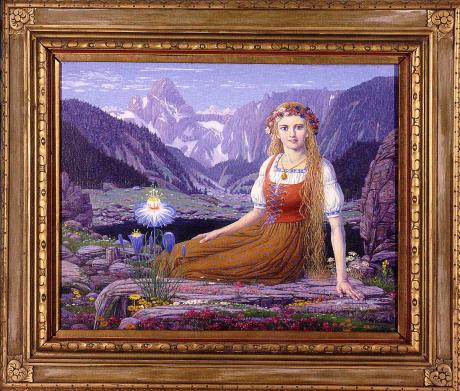 is as German as all get-out, is as German as all get-out, as is this:  but isn't this next one as Tolkien as all get-out? 
__________________
The entire plot of The Lord of the Rings could be said to turn on what Sauron didn’t know, and when he didn’t know it. Last edited by William Cloud Hicklin; 02-02-2013 at 12:19 AM. |
|
|
|
|
02-02-2013, 12:25 AM
|
#32 |
|
Loremaster of Annúminas
Join Date: Oct 2006
Posts: 2,331
|
This BTW is Madlener himself:
 Gandalf?
__________________
The entire plot of The Lord of the Rings could be said to turn on what Sauron didn’t know, and when he didn’t know it. |
|
|
|
|
02-02-2013, 02:19 AM
|
#33 | |
|
Wight
Join Date: Jan 2013
Location: Black Country, West Midlands
Posts: 130
|
Quote:
I also like the British Pre-Raphaelites and Art Nouveau even though they added to the trend of depicting Iron Age Celtic knights in medieval Teutonic (Germanic) armour. Historically inaccurate but giving us the popular imagery we now think of as Arthurian. I know how keen Tolkien was on Germanic saga, but none the less, probably because of the power of Arthurian tales in British culture, I find it hard not to see Gandalf as Merlin.
__________________
We see everything from behind, and it looks brutal. That is not a tree, but the back of a tree ...everything is stooping and hiding a face. ~ G.K. Chesterton |
|
|
|
|
 |
|
|
|
|


 Linear Mode

